A Lab-Grown Diamond Shaped Like a Rough Natural Crystal: What Does It Actually Show?
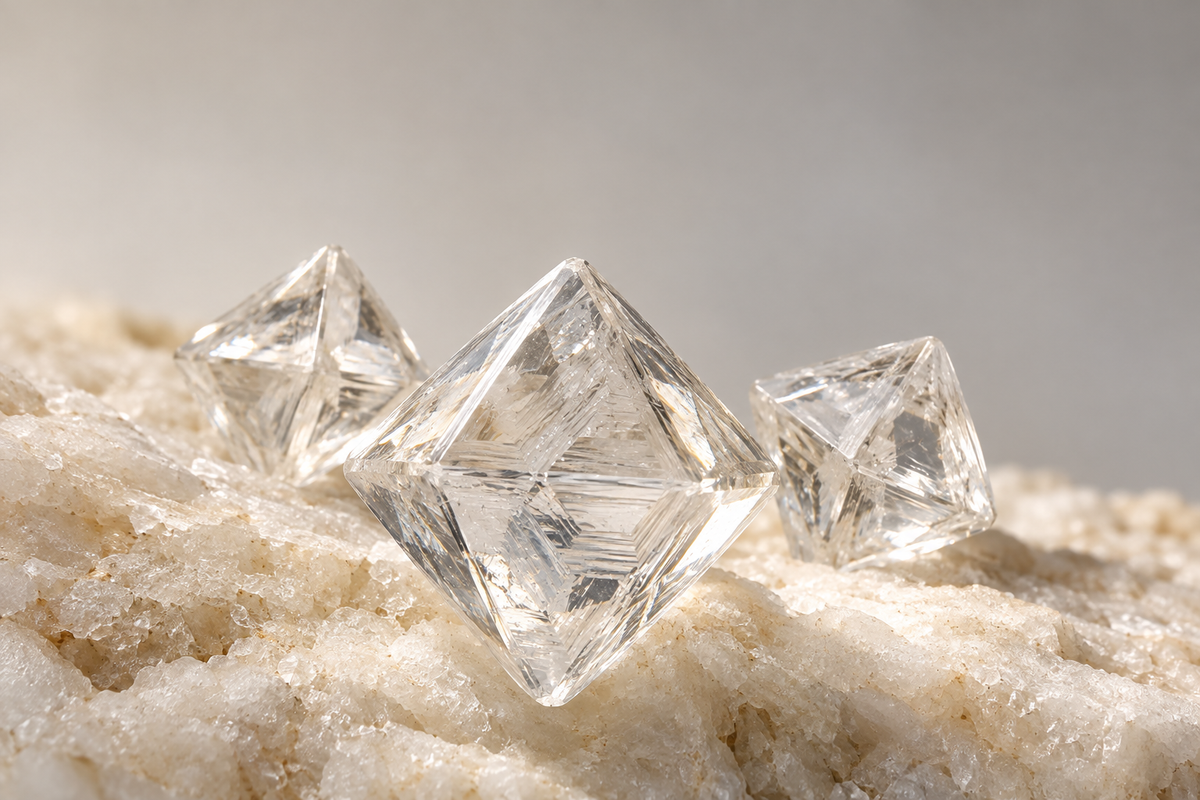
A new gemmological report describes a lab-grown diamond fashioned so that its outer shape resembles a rough natural diamond. The headline sounds dramatic. What does the examination show—and what does it not show?
An unusual documented case
In the Spring 2026 issue of Gems & Gemology, Nick Davies, Sema Firat, David Fisher and Thoufieq Shaik described a 6.87-carat colourless to near-colourless CVD diamond. To the authors’ knowledge, it was the first reported case of a CVD synthetic diamond deliberately fashioned to resemble a natural rough diamond crystal.
From a distance it looked like an eight-sided crystal, but closer examination in the laboratory showed that the crystal’s flat faces and orientation did not match a natural octahedron. Advanced analysis and luminescence imaging showed that it was CVD-grown.
What the report does not say
The authors explicitly state that they have no evidence of widespread substitution of synthetic and natural diamonds in the rough-diamond supply chain. This is one documented case—not proof that it happens on a large scale or that an ordinary polished diamond cannot be identified.
The report does show why outer shape, apparent weight or a quick glance is not enough to identify rough material with certainty. Gemmologists use laboratory examinations and specialised instruments when origin needs to be determined.
Why report a case like this?
New ways of working with material are relevant for the trade and laboratories to know about. But a finding should be described in proportion: a possible risk to watch for is not the same as evidence of a common market practice.
One further point: the authors are affiliated with De Beers Science & Technology. That does not invalidate the study, but it is relevant background when considering who produced the report and what conclusions it actually draws.
What customers should take away
When buying a polished diamond, the stated origin should be supported by a report from an established laboratory, and the report number should be checked. If a question about a rough diamond or its identity requires more than the documents can show, the seller should say so clearly and refer the matter to qualified laboratory examination.
The factual conclusion is not that every diamond is suspect. It is that reliable identification depends on examination and documentation—not on a convincing story or on how a stone looks from the outside.
Source
Nick Davies, Sema Firat, David Fisher and Thoufieq Shaik, “CVD Synthetic Fashioned to Imitate a Rough Natural Diamond”, Gems & Gemology, Spring 2026, Vol. 62, No. 1. The authors are affiliated with De Beers Science & Technology. Read the report at GIA.